EDWARDS HEM1 Lifesciences Hemosphere Advanced Monitor 30
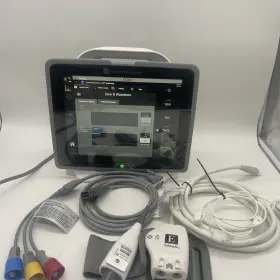
( Brand: Edwards ), ( Part Type: Monitor ), ( Manufacturer Part Number: HEM1 )
Review EDWARDS Lifesciences Hemosphere Advanced Monitor 30 Day Warranty
The Edwards HEM-1 LifeSciences Hemosphere Advanced Monitor 30 is a state-of-the-art hemoglobin oximetry and volume monitoring system designed for use during open heart surgery and other invasive medical procedures. This device provides real-time, non-invasive measurement of hemoglobin oxygen saturation (SpO2), total hemoglobin (tHb), and volumetric data, enabling healthcare professionals to optimize patient care and manage blood loss more effectively.
The Hemosphere Advanced Monitor 30 utilizes Edwards' proprietary MultiWave Technology, which employs multiple wavelengths of light to measure oxygen saturation more accurately than traditional pulse oximetry methods. This technology also enables the device to differentiate between different types of hemoglobin, such as fetal and methemoglobin, providing valuable diagnostic information.
The volumetric data offered by the Hemosphere Advanced Monitor 30 includes stroke volume, cardiac output, and other essential hemodynamic parameters. These measurements are calculated using a combination of pulse pressure analysis and plethysmographic techniques, allowing healthcare professionals to assess cardiac function and manage fluid resuscitation more effectively.
The Hemosphere Advanced Monitor 30 features a user-friendly interface, with clear, real-time display of all measured parameters. The device is also connected to a central monitoring system, allowing healthcare professionals to monitor multiple patients simultaneously and receive alerts for critical events.
The Hemosphere Advanced Monitor 30 is designed for use in a wide range of surgical and critical care settings, with a rugged, waterproof construction that can withstand the rigors of the operating room or intensive care unit. The device is also compatible with a variety of patient monitoring systems and connectivity options, making it a versatile and essential tool for healthcare professionals.
Overall, the Edwards HEM-1 LifeSciences Hemosphere Advanced Monitor 30 is an advanced, versatile, and essential tool for managing patient care during invasive medical procedures. Its accurate and reliable measurement of hemoglobin oxygen saturation, total hemoglobin, and volumetric data enables healthcare professionals to optimize patient care, manage blood loss effectively, and improve outcomes.
The Edwards Lifesciences HemoSphere Advanced Monitoring System (HAMS) is a non-invasive hemoglobin oximeter designed for continuous monitoring of hemoglobin (Hb) and oxygen saturation (SpO2) levels in critically ill patients. Here are some pros and cons of buying this device:
Pros:1. Non-invasive: The HAMS is a non-invasive device, which means it does not require blood samples for measurement like traditional laboratory methods. This can reduce the risk of infection, discomfort, and the need for frequent blood draws.
2. Continuous monitoring: The device provides real-time, continuous monitoring of Hb and SpO2 levels, allowing healthcare professionals to quickly identify trends and respond to changes in a patient's condition.
3. Improved patient care: Accurate and timely Hb monitoring can help healthcare professionals make informed decisions regarding blood transfusions, fluid resuscitation, and other interventions to optimize patient care.
4. Reduced laboratory costs: The HAMS can help reduce the need for frequent laboratory tests and associated costs, particularly in intensive care settings where patients may require frequent Hb monitoring.
5. User-friendly: The device is reportedly easy to use and can be integrated with other monitoring systems, such as electronic health records (EHRs) and patient monitors.
Cons:1. Expensive: The HAMS is a costly investment, with a high price tag for the device itself and ongoing costs for consumables, such as sensors and calibration solutions.
2. Limited accuracy: While the HAMS is generally accurate for measuring Hb levels, it may not be as precise as laboratory methods. Factors such as patient motion and temperature can affect the accuracy of the readings.
3. Maintenance requirements: The device requires regular calibration and maintenance to ensure accurate readings. This can add to the overall cost and workload for healthcare facilities.
4. Limited availability: The HAMS is not yet widely available in all markets, and healthcare facilities may need to work with their suppliers to obtain the device and associated consumables.
In conclusion, the Edwards Lifesciences HemoSphere Advanced Monitoring System offers several benefits, including non-invasive Hb and SpO2 monitoring, real-time trending, and potential cost savings. However, the high cost, limited accuracy, and maintenance requirements may be significant drawbacks for some healthcare facilities. Ultimately, the decision to purchase the HAMS should be based on a careful assessment of the specific needs and resources of the institution.
Based on the information provided, I would recommend considering the HAMS as an option for continuous Hb monitoring in critically ill patients if the benefits outweigh the costs for your healthcare facility. It is important to carefully evaluate the potential impact on your budget, staff workload, and patient care, and to weigh the advantages against those of alternative monitoring methods. Consulting with experts in your organization, such as laboratory staff, clinicians, and technology specialists, can help inform your decision-making process.
Details:
Medical and dental items must be inspected for safety by a biomedical technician before being placed into use. Regardless of the origin equipment, documentation provided or identification appearing upon equipment described and offered here is in no way certified for, recommended for any specific use. Orlando, FL 32825. Comes With HEMDPT10 HEMP EVHRS, PC2, Boa Med Tech.
11492 Yangon Road.
part #: hem1 price
- $4490.00
specifications quakedental:
- brand: Edwards
- part type: Monitor
- manufacturer part number: HEM1
shipping quakedental:
- cost: $0.00
- transit: 3-6 Days
- class: Economy
- service: FedEx Ground Economy
- type: Calculated
- carrier: FedEx
seller quakedental:
- city: Orlando, Florida
- # reviews: 4694
- rating: 99.6%
offer quakedental:
- availability: In Stock
- quantity: 1
- started: October 19, 2025
- options: Ship-to-home
- best offers: True
- sold: 0
general quakedental:
- condition: Used
- Business Industrial > Healthcare, Lab Dental > Other Healthcare, Lab Dental
payments quakedental:
- credit card: Visa
- other
- wallet: Google-pay
returns quakedental:
- method: Money back
- time: 30 Days
- policy: Returns Accepted
- paid by: Buyer
Edwards HEM1 Is Similar To:
- Edwards Ref-70cc2 Used Lifesciences Patient Cco Cable Ref 70cc2 (40.9% similar) Used in excellent condition...(June 18th, 2024)
- Edwards Hempsc100 Lifesciences Hemosphere Pressure Cable (64% similar) Part #: Edwards hemp for sale...(July 21st, 2024)
- Edwards Evftc1 Lifesciences Flotrac Cable Ev1000 (46.2% similar) Edwards lifesciences flytrap cable AFDC 1 EV1000. Shipped with USPS priority mail padded flat rate envelope. Condition is used...(August 16th, 2024)
- Lifesciences Px1800 Edwards Truwave Reusable Cables 896004021 Lot Of 3 (28.4% similar) Please look at all pictures and go through detail before buying. Completeness: with everything seen in the pictures. View item the images and see them with zooming. Regardless of the origin products, documentation provided or identification appearing upon items, items described and...(September 18th, 2024)
- Edwards Com2-cc Lifesciences Qty 1 Lot 1017 (44.6% similar) Part #: Edwards COM2-CC for sale...(July 3rd, 2025)
- Edwards Mp111n Lot Of 28 Lifesciences Clip Bracket Adapters Iv Pole (50% similar) The items are in mixed condition. All are in good shape. I have provided pictures for you to determine the condition of item. The item you are buying on is a lot of 28 Edwards lifesciences MP111N clip bracket adapters...(November 8th, 2025)
- Edwards Lifesciences Tray1133 Magna Ease Accessory Set (52% similar) Current rates are $175 for packing and pelleting each standard pallet standard size is 48 X40 X60 $300 non-standard. Oem: Edwards lifesciences. Reline will attempt to replace product prior issuing credit. Shipping cost is calculated by zip code and available at the top of page...(January 10th, 2026)
- Edwards 650363-044 Lifesciences Om2 Oximetry Optical Module Cable (44.8% similar) Edwards lifesciences OM2 oxymora optical module cable 650363-044...(April 11th, 2026)

1 offer $4490.00 USD
- New – Open box. Offer #1 priced at $4490.00 + $99.47 delivery = $4589.47* total. HemoSphere Pressure-Out Cable (HEMDPT1000). 1.1 Edwards.+$99.47 shipping